
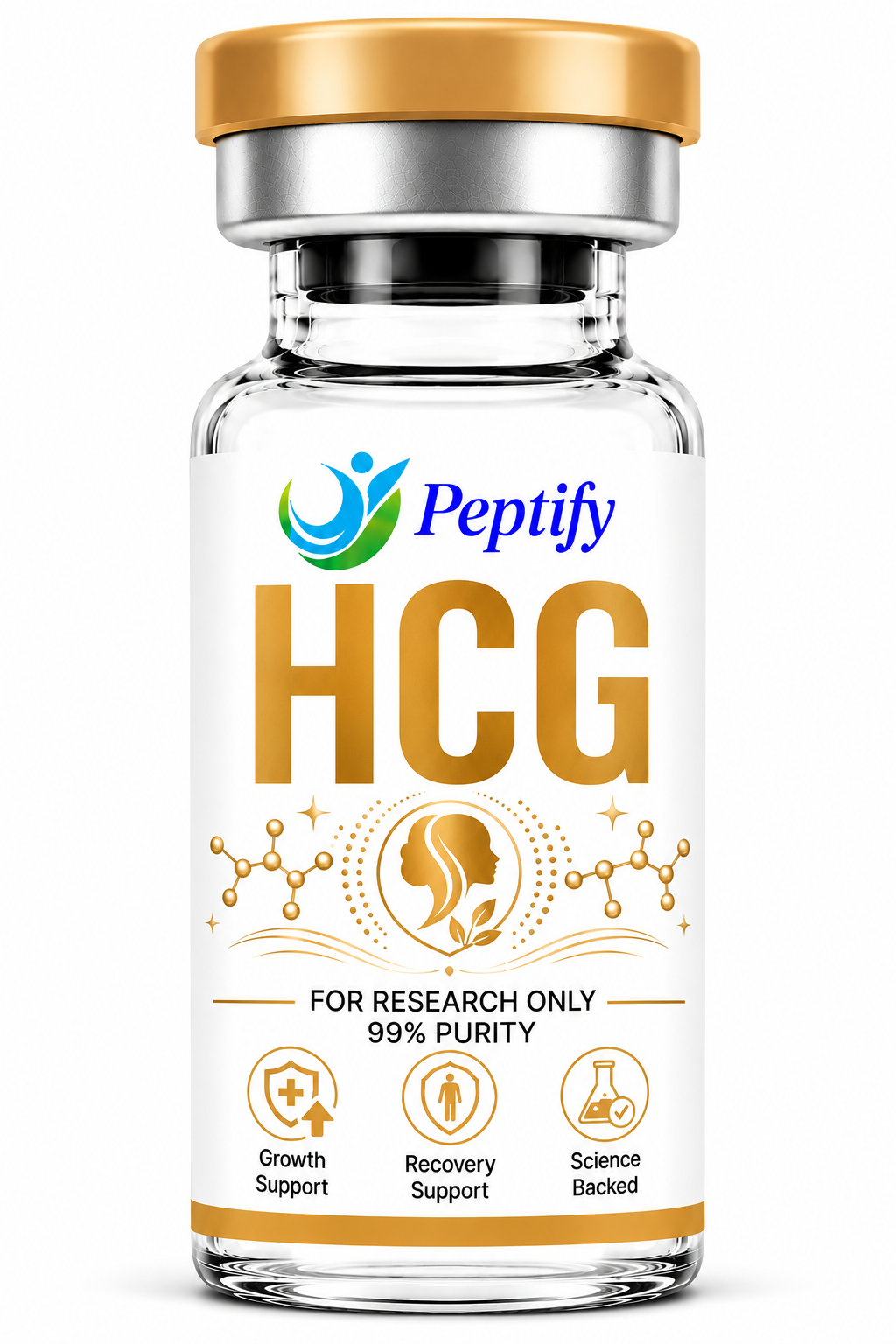
HCG 10000 IU
A prescription hormone entry for fertility and endocrine-use context with clinician monitoring.
Contents
Use this guide as a structured review page. The same headings appear for every protocol so clients and the care team can scan the page consistently.
Important Note
This page is informational and does not authorize use. Peptify clients should complete assessment, disclose medications and health history, and follow the clinician-approved plan only.
- Do not start, stop, combine, or change a protocol based only on website content.
- Emergency symptoms require urgent medical care, not a website or routine follow-up message.
Quickstart Highlights
Human chorionic gonadotropin (HCG) is a glycoprotein hormone that mimics luteinizing hormone (LH) at the LH/CG receptor[1]. In men it stimulates testicular Leydig cells to produce testosterone and support spermatogenesis; in women it triggers ovulation and luteal progesterone. Urinary HCG is FDA-approved for male hypogonadotropic hypogonadism, prepubertal cryptorchidism, and ovulation induction[7]. The TRT-adjunct “testicular maintenance / fertility preservation” and post-cycle uses this page centers on are off-label. HCG is a prescription drug requiring medical supervision and is WADA-prohibited in male athletes — presented for educational purposes only.
- Add 2.0 mL bacteriostatic water to one 5000 IU vial → 2,500 IU/mL.
- 500 IU subcutaneous, 3× weekly (Mon/Wed/Fri) for testicular maintenance during TRT — weekly total 1,500 IU.
- At 2,500 IU/mL, 1 unit = 25 IU on a U-100 syringe; 500 IU = 20 units (0.20 mL). About 10 doses per vial.
- Lyophilized: refrigerate at 2–8 °C (35.6–46.4 °F); after reconstitution, refrigerate for up to 60 days and do not freeze.
- Important: Start with the Prep & Injection Guide — it covers the preparation and safety basics every protocol on this site assumes.
Dosing & Reconstitution Guide
IU-based subcutaneous dosing on a U-100 insulin syringe, step by step
| Phase / Week(s) | Dose per Injection | Volume (U-100 units / mL) |
|---|---|---|
| Weeks 1–4 | 1,500 IU (3× weekly) | 60 units (0.60 mL) |
| Weeks 5–8 | 2,000 IU (3× weekly) | 80 units (0.80 mL) |
| Weeks 9–12 | 1,000 IU (3× weekly) | 40 units (0.40 mL) |
- Reconstitute: Add 2.0 mL bacteriostatic water to one 5000 IU vial → final concentration 2,500 IU/mL.
- Typical dosing: 500 IU subcutaneous, 3× weekly (Mon/Wed/Fri) for testicular maintenance during TRT — weekly total 1,500 IU.
- Easy measuring: At 2,500 IU/mL, 1 unit = 25 IU on a U-100 syringe, so 500 IU = 20 units (0.20 mL). About 10 doses per vial (units = IU ÷ 25).
- Storage: Lyophilized: refrigerate at 2–8 °C (35.6–46.4 °F); after reconstitution refrigerate for up to 60 days and do not freeze.
- Frequency: inject 3 times weekly subcutaneously (e.g., Monday/Wednesday/Friday), for a total weekly dose of 1,500 IU. This maintains intratesticular testosterone during exogenous testosterone therapy and supports fertility preservation[3][4]. Dosing calculations: 250 IU = 10 units (0.10 mL); 500 IU = 20 units (0.20 mL); 1,000 IU = 40 units (0.40 mL).
- Frequency: inject 3 times weekly subcutaneously. High-dose protocols (1,500–2,500 IU per injection) are used to reactivate testosterone production after prolonged anabolic steroid use or in severe hypogonadotropic hypogonadism[5][6]. After initial recovery, doses are typically reduced to maintenance levels (500–1,000 IU 3×/week).
Reconstitution Steps
Draw 2.0 mL of bacteriostatic water into a sterile syringe.
- Inject slowly down the vial’s inner wall to limit foaming — avoid vigorous shaking.
- Swirl or roll gently until the powder fully dissolves into a clear solution.
- Label with the reconstitution date and concentration (2,500 IU/mL), then refrigerate immediately at 2–8 °C (35.6–46.4 °F).
- The 2.0 mL dilution gives a clean 2,500 IU/mL, so a 500 IU maintenance dose reads at exactly 20 units on a U-100 syringe. Do not freeze the reconstituted solution; refrigerate and discard after 60 days or if cloudiness or particles appear.
- Important: This guide is for educational purposes only and is not medical advice. HCG is a prescription drug; use only under qualified medical supervision.
Supplies Needed
Quantities below assume an 8–16 week course using standard 500 IU × 3 times weekly dosing (1,500 IU/week).
- Each vial delivers ~10 maintenance doses (1,500 IU/week), so plan a few vials per 8–16 week course.
- 8 weeks (12,000 IU total): 3 vials
- 12 weeks (18,000 IU total): 4 vials
- 16 weeks (24,000 IU total): 5 vials
- Per week: 3 syringes (Mon/Wed/Fri)
- 8 weeks: 24 syringes
- 12 weeks: 36 syringes
- 16 weeks: 48 syringes
- Use 2.0 mL per 5000 IU vial for reconstitution.
- 8 weeks (3 vials): 6 mL → 1 bottle
- 12 weeks (4 vials): 8 mL → 1 bottle
- 16 weeks (5 vials): 10 mL → 1 bottle
- One for the vial stopper + one for the injection site each injection day.
- Per week: 6 swabs (2 × 3 injections)
- 8 weeks: 48 swabs → 1 box
- 16 weeks: 96 swabs → 1 box
Protocol Overview
A concise summary of the 3×-weekly HCG regimen.
- ▪Goal: Maintain testicular function and fertility during testosterone replacement therapy, or restore endogenous testosterone production post-cycle[3][4].
- ▪Schedule: Subcutaneous injections 3 times weekly (Mon/Wed/Fri) for 8–16 weeks.
- ▪Dose Range: Standard maintenance 500 IU per injection (1,500 IU/week); high-dose recovery 1,500–2,500 IU per injection.
- ▪Reconstitution: 2.0 mL per 5000 IU vial gives 2,500 IU/mL for precise insulin-syringe measurements (1 unit = 25 IU).
- ▪Storage: Refrigerate lyophilized and reconstituted vials at 2–8 °C; reconstituted solution stable up to 60 days. Do not freeze.
Dosing Protocol
Evidence-based HCG dosing approaches drawn from clinical literature.
- ▪Standard maintenance: 500 IU SC on Monday/Wednesday/Friday maintains intratesticular testosterone at near-normal levels during TRT[4].
- ▪High-dose recovery: 1,500–2,500 IU SC 3×/week for 3–6 months to restart spermatogenesis and testosterone production after anabolic steroid cessation[5][6].
- ▪Frequency: Due to HCG’s ~36-hour half-life, 3 times weekly is sufficient; daily injections are unnecessary[2].
- ▪Cycle length: 8–12 weeks typical; extend to 16+ weeks for severe suppression.
- ▪Timing: Keep consistent days/times and rotate injection sites (abdomen, thighs).
Storage Instructions
Proper storage maintains HCG potency throughout your protocol.
- ▪Lyophilized (unreconstituted): Refrigerate at 2–8 °C (35.6–46.4 °F); room temperature is acceptable but refrigeration is preferred for long-term storage[8].
- ▪Reconstituted: Must be refrigerated at 2–8 °C; stable for up to 60 days when reconstituted with bacteriostatic water[9].
- ▪Do not freeze reconstituted HCG — freezing denatures the protein[9].
- ▪Light & labeling: Store in light-protected packaging; label with the reconstitution date and discard after 60 days or if cloudiness or particles appear.
Important Notes
Practical points for safe and effective HCG administration.
- ▪Sterile technique: Use a new sterile insulin syringe each time, wipe the vial stopper with alcohol before each draw, and never reuse needles[10].
- ▪Site rotation: Rotate between abdomen (2+ inches from the navel), outer thighs and upper arms to prevent irritation and lipohypertrophy[10].
- ▪Injection speed: Inject slowly and wait 5–10 seconds before withdrawing the needle to ensure full dispersal.
- ▪Monitoring: Consider periodic testosterone and estradiol testing — HCG can increase estradiol conversion in some individuals.
- ▪Regulatory note: HCG is a prescription drug requiring medical supervision. Urinary HCG is FDA-approved for hypogonadotropic hypogonadism, cryptorchidism and ovulation induction; the TRT-adjunct and PCT uses here are off-label, and HCG is WADA-prohibited in male athletes (Category S2)[7].
How This Works
HCG (human chorionic gonadotropin) is a glycoprotein hormone that mimics luteinizing hormone (LH) by binding the shared LH/CG receptor in the gonads[1]. With an extended ~36-hour half-life (versus LH’s ~30 minutes), it provides sustained gonadal stimulation[2].
- In men, HCG stimulates testicular Leydig cells to produce testosterone, maintaining intratesticular testosterone and supporting spermatogenesis even when exogenous testosterone suppresses natural LH. In women, it triggers ovulation and luteal progesterone production.
- Studies show that low-dose HCG (250–500 IU every other day, or 500 IU 3×/week) maintains intratesticular testosterone at near-baseline levels in men receiving testosterone therapy[4]. Higher doses (1,500–5,000 IU multiple times weekly) are used to restore spermatogenesis and endogenous testosterone in hypogonadotropic hypogonadism or post-anabolic-steroid recovery[5][6].
- Approval & framing: Urinary HCG (Pregnyl, Novarel) is FDA-approved for male hypogonadotropic hypogonadism, prepubertal cryptorchidism and ovulation induction; recombinant Ovidrel is approved for fertility only. The testicular-maintenance, fertility-preservation and PCT uses described on this page are off-label. HCG is a prescription drug requiring medical supervision and is not a testosterone-boosting or bodybuilding agent.
Lifestyle Factors
Complementary strategies to support hormonal health alongside the protocol.
- ▪Sleep optimization: Aim for 7–9 hours of quality sleep; sleep deprivation impairs testosterone production and fertility.
- ▪Stress management: Chronic stress elevates cortisol, which antagonizes testosterone production — build in stress-reduction practices.
- ▪Nutrition: Maintain adequate dietary fats for steroid-hormone synthesis and sufficient protein and micronutrients (zinc, vitamin D, magnesium).
- ▪Exercise: Resistance training supports anabolic hormone production; avoid chronic excessive endurance exercise, which can suppress testosterone.
- ▪Avoid testicular heat & limit alcohol: Minimize hot-tub/sauna use and tight underwear to protect spermatogenesis, and keep alcohol moderate.
Potential Benefits & Side Effects
Documented effects from clinical literature and medical practice; individual results vary and medical supervision is required.
- ▪Fertility preservation: Maintains intratesticular testosterone and spermatogenesis during TRT[3][4].
- ▪Testicular size: Helps prevent or reverse testicular atrophy associated with exogenous testosterone use.
- ▪Testosterone recovery: Restores endogenous testosterone in hypogonadotropic hypogonadism or post-cycle scenarios[5][6].
- ▪Downstream hormones: Provides physiologic downstream hormone production (e.g., pregnenolone, DHEA) that exogenous testosterone alone does not.
- ▪Estradiol elevation: HCG stimulates testicular aromatase, potentially raising estradiol and requiring monitoring.
- ▪Injection-site reactions: Mild redness, swelling or discomfort that typically resolves quickly.
- ▪Acne / oily skin & testicular discomfort: Possible as testosterone and estradiol rise and dormant Leydig cells reactivate.
- ▪Gynecomastia risk: Rare but possible if estradiol becomes significantly elevated without management.
Injection Technique
General subcutaneous technique for HCG, following established clinical best-practice guidance[10][11].
- ▪Wash your hands thoroughly with soap and water.
- ▪Remove the HCG vial from the refrigerator; wipe the rubber stopper with an alcohol swab and let it air-dry.
- ▪Draw the prescribed dose into a U-100 insulin syringe (e.g., 500 IU = 20 units) and tap out any air bubbles.
- ▪Select an injection site (abdomen, thigh or upper arm) and clean it with a fresh alcohol swab, letting it dry fully[11].
- ▪Site selection: Abdomen (2+ inches from the navel), outer thigh or back of the upper arm — rotate sites systematically.
- ▪Pinch technique: Pinch a fold of skin between thumb and forefinger[11].
- ▪Needle angle: Insert at a 90-degree angle for most people, or 45 degrees if very lean[12].
- ▪Skip aspiration for subcutaneous injections — it is not needed. Slowly depress the plunger to inject[12].
- ▪Wait 5–10 seconds, then withdraw the needle at the same angle. Gently press (don’t rub) the site with clean gauze.
- ▪Immediately dispose of the used syringe in a puncture-proof sharps container — never recap a needle.
- ▪Return the HCG vial to the refrigerator promptly.
- ▪Rotate the injection site each time to prevent irritation and lipohypertrophy[9].
- ▪Document the injection date, dose and site for consistency throughout the protocol.
Recommended Source
For high-purity research peptides, we point researchers to Prime Lab Peptides.
- ▪Top-rated on Trustpilot: Independently reviewed as the highest-rated peptide lab on Trustpilot — making it the best current source in the USA. Open source
- ▪Third-party tested: Every batch ships with a Certificate of Analysis (COA) confirming purity and composition.
- ▪Consistent quality: ISO-aligned manufacturing and handling keep product integrity reliable batch to batch.
- ▪Cold-chain integrity: Temperature-controlled shipping and storage across the whole fulfilment chain.
- ▪Research-grade purity: Fit for educational and research use that demands high-quality peptides.
- Note: Product availability and specifications subject to change. Verify current product details on the supplier website.
- Shop at Prime Lab Peptides →
References
Reference-derived details for HCG 10000 IU.
- HCG (5000iu Vial) Dosage Protocol Open source
- 1 National Center for Biotechnology Information (NCBI) Human chorionic gonadotropin: structure, function and LH/CG receptor binding mechanism. View Source ↗ Open source
- 2 Seminars in Reproductive Medicine Pharmacokinetics and pharmacodynamics of HCG: extended ~36-hour half-life and sustained gonadal activity. View Source ↗ Open source
- 3 Translational Andrology and Urology (2018) Lee JA & Ramasamy R: hCG for hypogonadal male infertility (typical regimens 1,500–5,000 IU 2–3×/week). View Source ↗ Open source
- 4 J. Clinical Endocrinology & Metabolism (2005) Coviello AD et al: low-dose hCG maintains intratesticular testosterone during testosterone-induced gonadotropin suppression. View Source ↗ Open source
- 5 Male Infertility Clinical Commentary hCG dosing: 500 IU SC 3×/week for maintenance; 1,000–4,000 IU 3×/week for post-androgen recovery. View Source ↗ Open source
- 6 Drugs.com (2025) HCG dosage guide: adult male hypogonadism 500–1,000 IU IM 3×/week, or 4,000 IU 3×/week for 6–9 months. View Source ↗ Open source
- 7 Mayo Clinic Chorionic gonadotropin drug description: ovulation induction, sperm production and cryptorchidism; FDA-approved indications. View Source ↗ Open source
- 8 University Hospitals Fertility Center Patient instructions for low-dose HCG: storage and handling guidance (refrigerate after mixing). View Source ↗ Open source
- 9 FDA Prescribing Information Chorionic Gonadotropin (Pregnyl/Novarel): reconstituted solution stable 60 days when refrigerated; do not freeze. View Source ↗ Open source
- 10 NCBI Bookshelf Best practices for subcutaneous injection: aseptic technique and site rotation. View Source ↗ Open source
- 11 University Hospitals Fertility Center SC injection technique for HCG: clean site, pinch skin, insert straight in, inject slowly; never reuse syringes. View Source ↗ Open source
- 12 Centers for Disease Control and Prevention (CDC) Subcutaneous injection technique: 45–90° angle, no aspiration required. View Source ↗ Open source
- 13 WADA Prohibited List Chorionic gonadotropin (Category S2) is prohibited in male athletes. View Source ↗ Open source
- 14 Prime Lab Peptides High-purity research-grade HCG (5000 IU) with third-party testing and COA documentation. View Source ↗ Open source