
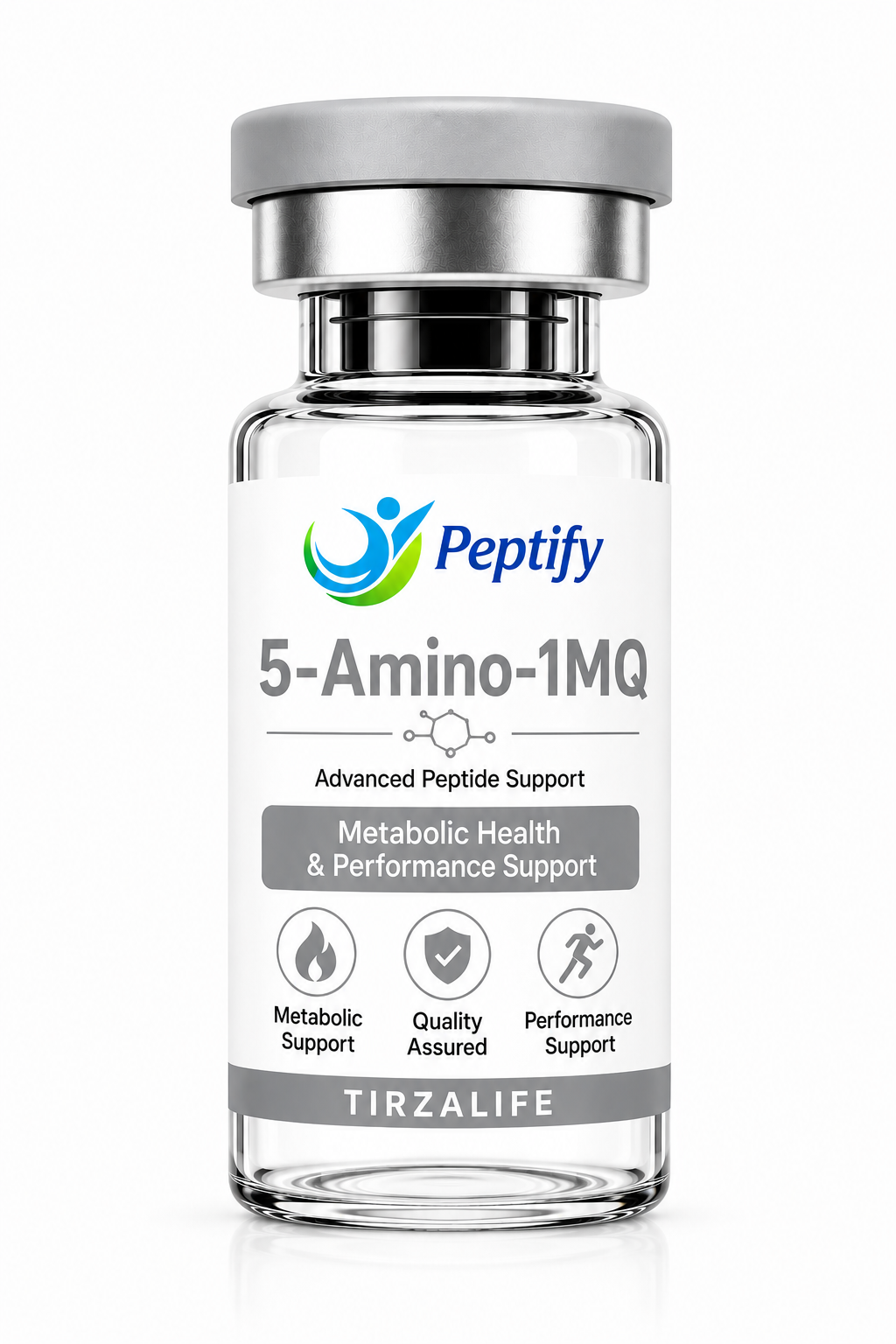
5-Amino-1MQ 5mg
A metabolic research entry for NNMT-inhibitor literature and high-caution review.
Contents
Use this guide as a structured review page. The same headings appear for every protocol so clients and the care team can scan the page consistently.
Protocol Overview
5-Amino-1MQ is discussed in research as a nicotinamide N-methyltransferase inhibitor with interest in NAD-related metabolism, adipocyte biology, and energy-expenditure models. It is not an approved metabolic treatment, so review should remain research-focused with medication history, liver and kidney context, pregnancy status, and clinician oversight.
- NNMT-inhibitor research context
- NAD-related metabolism review
- Liver/kidney safety screening
- Clinician-guided discussion
Important Note
This page is informational and does not authorize use. Peptify clients should complete assessment, disclose medications and health history, and follow the clinician-approved plan only.
- Do not start, stop, combine, or change a protocol based only on website content.
- Emergency symptoms require urgent medical care, not a website or routine follow-up message.
Quickstart Highlights
5-Amino-1MQ (5-amino-1-methylquinolinium) is a small molecule — not a peptide — that selectively inhibits nicotinamide N-methyltransferase (NNMT), an enzyme overexpressed in fat tissue. In animal and cell studies, blocking NNMT is theorized to raise intracellular NAD+ and activate SIRT1, which researchers have linked to fat oxidation and preserved lean mass[1][2]. It is not FDA-approved for anything and has no completed human clinical trials — every effect below is preclinical (rodent/cell) only. Note also that 5-Amino-1MQ is well documented as orally bioavailable and is usually sold and dosed as an oral capsule; the subcutaneous approach on this page is this site’s framing, not the standard route. Presented for research and educational use only.
- Add 3.0 mL bacteriostatic water to one 10 mg vial → ~3.33 mg/mL, a clean concentration for accurate dosing.
- 150–600 mcg once daily (subcutaneous in this framing), reached by gradual titration over 8 weeks.
- At 3.33 mg/mL, 1 unit = 0.01 mL ≈ 33.3 mcg; 150 mcg = 4.5 units and 600 mcg = 18 units on a U-100 syringe.
- Lyophilized: store at −20 °C (−4 °F); once reconstituted, refrigerate at 2–8 °C (35.6–46.4 °F) and protect from light.
- Important: Start with the Prep & Injection Guide — it covers the preparation and safety basics every protocol on this site assumes.
Dosing & Reconstitution Guide
A single practical dilution with simple unit math, step by step
| Phase / Week(s) | Daily Dose & Frequency | Volume (U-100 units / mL) |
|---|---|---|
| Weeks 1–2 (Ramp) | 150 mcg once daily | 4.5 units (0.045 mL) |
| Weeks 3–4 (Titrate) | 300 mcg once daily | 9.0 units (0.090 mL) |
| Weeks 5–8 (Target) | 600 mcg once daily | 18 units (0.18 mL) |
- Reconstitute: Add 3.0 mL bacteriostatic water to one 10 mg vial → final concentration ~3.33 mg/mL.
- Typical daily range: 150–600 mcg once daily — 150 mcg/day to start, titrating gradually to 600 mcg/day over 8 weeks.
- Easy measuring: At 3.33 mg/mL, 1 unit = 0.01 mL ≈ 33.3 mcg on a U-100 syringe. Units = mcg ÷ 33.3.
- Storage: Lyophilized: store at −20 °C (−4 °F); after reconstitution, refrigerate at 2–8 °C (35.6–46.4 °F), protect from light, and use within 2–4 weeks.
- Frequency: one subcutaneous injection per day in this framing. This stepwise titration lets you monitor tolerance while gradually reaching the effective dosing levels observed in preclinical research[1][4]. One 10 mg vial provides roughly 16–20 days of material at the 600 mcg/day target, and longer during the ramp weeks. For ≤10-unit (≤0.10 mL) administrations, consider 30- or 50-unit insulin syringes for improved readability. These figures come from preclinical and pharmacokinetic literature, not from approved human dosing — and note the standard route for this molecule is oral.
Reconstitution Steps
Remove the vial from freezer storage (−20 °C / −4 °F) and let it equilibrate at room temperature for 15–20 minutes.
- Draw 3.0 mL of bacteriostatic water into a sterile syringe and release it slowly down the vial’s inner wall to limit foaming.
- Swirl or roll gently until fully dissolved — the solution should be clear. Don’t shake.
- Label with the date and concentration, then refrigerate at 2–8 °C (35.6–46.4 °F), shielded from light; use within 2–4 weeks.
- The 3.0 mL fill gives ~3.33 mg/mL, so 1 unit ≈ 33.3 mcg on a U-100 syringe (150 mcg = 4.5 units, 600 mcg = 18 units). Do not freeze the reconstituted solution.
- Important: This guide is for educational purposes only and is not medical advice. For research use only. Not for human consumption.
Supplies Needed
Quantities below assume research use with the 10 mg vial format across an 8–16 week daily protocol with gradual titration.
- A 10 mg vial covers roughly 16–20 days at the 600 mcg/day target, so plan across the titration schedule.
- 8 weeks: ~3 vials
- 12 weeks: ~4 vials
- 16 weeks: ~6 vials
- Per week (once daily): 7 syringes
- 8 weeks: 56 syringes
- 12 weeks: 84 syringes
- 16 weeks: 112 syringes
- Use ~3.0 mL per 10 mg vial for reconstitution.
- 8 weeks (3 vials): ~9 mL → 1 bottle
- 12 weeks (4 vials): ~12 mL → 2 bottles
- 16 weeks (6 vials): ~18 mL → 2 bottles
- One for the vial stopper + one for the injection site each administration (2/day).
- Per week: 14 swabs
- 8 weeks: 112 swabs → 2 × 100-count boxes
- 12 weeks: 168 swabs → 2 × 100-count boxes
- 16 weeks: 224 swabs → 3 × 100-count boxes
Important Notes
Practical points that keep administration safe and consistent.
- ▪Sterile technique: Use a fresh sterile U-100 insulin syringe each time and drop it straight into a puncture-proof sharps container afterward.
- ▪Site rotation: Move between abdomen, thighs and upper arms to reduce local irritation and lipohypertrophy[12].
- ▪Route note: 5-Amino-1MQ is well documented as orally bioavailable and is typically sold and dosed as an oral capsule. The subcutaneous approach here is this site’s framing, not the established route[4].
- ▪Recordkeeping: Log the daily dose, injection site and any observations to keep the protocol consistent.
- ▪Regulatory note: 5-Amino-1MQ is not FDA-approved for any use and has not been studied in completed human clinical trials; it is an investigational research chemical.
How This Works
5-Amino-1MQ (5-amino-1-methylquinolinium) is a synthetic small molecule — not a peptide — that selectively inhibits nicotinamide N-methyltransferase (NNMT)[1]. NNMT methylates nicotinamide (a form of vitamin B3) using S-adenosylmethionine (SAM) as the methyl donor. In obesity and metabolic dysfunction, NNMT is often overexpressed in adipose tissue, depleting nicotinamide and lowering NAD+ availability[2].
- By inhibiting NNMT, 5-Amino-1MQ is theorized to spare nicotinamide for NAD+ synthesis, raising intracellular NAD+ and activating SIRT1 (Sirtuin 1) pathways tied to mitochondrial biogenesis and fat oxidation[3]. In rodent and cell work, NNMT knockdown or inhibition has been described as protecting against diet-induced weight gain and improving metabolic measures without reducing food intake[5][6].
- Some preclinical work has also reported preserved or enhanced lean muscle — for example, greater grip strength in aged mice when combined with exercise[7]. These remain animal and cell-culture findings.
- Important caveat: there are no completed human clinical trials of 5-Amino-1MQ. Every fat-metabolism, NAD+, SIRT1 and lean-mass effect described above is preclinical (rodent or cell) only and should be read as a hypothesis, not an established human benefit. Nothing here implies weight-loss efficacy in people.
- Route: 5-Amino-1MQ is well documented as orally bioavailable and is usually sold and dosed as an oral capsule (commonly ~50–150 mg/day in product use)[4]. This page reframes it as a subcutaneous injection, which is the site’s choice; the standard route for this molecule is oral.
- 5-Amino-1MQ is not an approved medicine. It is an unapproved investigational research chemical presented here for research and educational purposes only.
Lifestyle Factors
Habits that may support metabolic health alongside the protocol.
- ▪Nutrition: Keep protein intake adequate and overall diet balanced to support metabolism and lean mass.
- ▪Activity: Pair regular resistance and aerobic exercise with the protocol — preclinical lean-mass effects were strongest when combined with exercise.
- ▪Sleep: Aim for 7–9 hours to support the body’s natural metabolic and repair processes.
- ▪Stress: Manage stress with evidence-based practices, since it influences overall metabolic health.
Potential Benefits & Side Effects
What preclinical literature describes. There is no completed human evidence, and individual results are unknown.
- ▪Fat metabolism: Animal models report reductions in fat mass while lean muscle is preserved[5][6].
- ▪NAD+ / SIRT1: Associated with elevated NAD+ and SIRT1 activation in preclinical studies[2][3].
- ▪Muscle strength: Enhanced grip strength observed in aged mice when combined with exercise[7].
- ▪Note on humans: These benefits are not established in humans — no completed clinical trials exist[1].
- ▪Mild, anecdotal: Occasional reports of mild headache, transient jitteriness, or injection-site reactions.
- ▪Injection-site reactions: Redness, tenderness or soreness can occur in this SC framing; rotating sites helps.
- ▪Unknown long-term profile: No human safety data, so caution and monitoring are advised.
Injection Technique
General subcutaneous technique, following established clinical best-practice guidance[10][11]. (The standard route for this molecule is oral; this covers the SC framing used on this page.)
- ▪Wash your hands well with soap and water.
- ▪Wipe the vial stopper with an alcohol swab and let it air-dry.
- ▪Choose a site (abdomen, thigh, or upper arm) and clean it with a fresh alcohol swab, letting it dry fully[11].
- ▪Draw the intended dose, then check for air bubbles and push any out.
- ▪Pinch a skinfold at the chosen site between thumb and forefinger.
- ▪Insert the needle into the pinch at a 45–90-degree angle (use 45 degrees if the fat layer is thin)[10].
- ▪Skip aspiration for subcutaneous shots — it isn’t needed[10].
- ▪Press the plunger slowly and steadily until it’s fully down.
- ▪Wait 5–10 seconds, then pull the needle straight out to prevent leakage.
- ▪Drop the used syringe straight into a puncture-proof sharps container — never recap a needle.
- ▪Return the reconstituted vial to the fridge right away.
- ▪Rotate the injection site each day to prevent irritation and lipohypertrophy[12].
- ▪Watch the site for excess redness, swelling, or signs of infection.
Recommended Source
For high-purity research compounds, we point researchers to Prime Lab Peptides.
- ▪Top-rated on Trustpilot: Independently reviewed as the highest-rated peptide lab on Trustpilot — making it the best current source in the USA. Open source
- ▪Third-party tested: Every batch ships with a Certificate of Analysis (COA) confirming purity and composition.
- ▪Consistent quality: ISO-aligned manufacturing and handling keep product integrity reliable batch to batch.
- ▪Cold-chain integrity: Temperature-controlled shipping and storage across the whole fulfilment chain.
- ▪Research-grade purity: Fit for educational and research use that demands high-quality compounds.
- Note: Product availability and specifications subject to change. Verify current product details on supplier website.
- Shop at Prime Lab Peptides →
References
Reference-derived details for 5-Amino-1MQ 5mg.
- 5-Amino-1MQ (10 mg Vial) Open source
- 1 Nature Medicine (2014) Nicotinamide N-methyltransferase knockdown protects against diet-induced obesity (preclinical). View Source ↗ Open source
- 2 PMC (2024) NNMT inhibition mitigates obesity-related metabolic dysfunctions in animal models. View Source ↗ Open source
- 3 Frontiers in Pharmacology (2024) NNMT as a candidate therapeutic target for metabolic syndrome (review). View Source ↗ Open source
- 4 PubMed (2021) LC-MS/MS assay for 5-amino-1-methylquinolinium: pharmacokinetics and oral bioavailability. View Source ↗ Open source
- 5 ResearchGate (2021) Combined NNMT inhibition and reduced-calorie diet normalizes body composition in obese mice. View Source ↗ Open source
- 6 PMC (2022) Reduced-calorie diet with NNMT inhibition establishes a distinct microbiome in DIO mice. View Source ↗ Open source
- 7 NMN.com / Scientific Reports NNMT inhibition and muscle strength: enhanced grip strength with exercise (preclinical). View Source ↗ Open source
- 8 Swolverine 5-Amino-1MQ mechanism, benefits, stacking and cycling overview (educational). View Source ↗ Open source
- 9 PMC Subcutaneous drug injection review: pharmacologic considerations. View Source ↗ Open source
- 10 CDC Vaccine administration: subcutaneous route (angle/site; no aspiration). View Source ↗ Open source
- 11 CDC (Subcut Injection PDF) Technique diagram and site guidance for subcutaneous injections. View Source ↗ Open source
- 12 NCBI Bookshelf Best practices for injection: asepsis, preparation and administration. View Source ↗ Open source
- 13 Journal of Medicinal Chemistry (ACS) Bisubstrate inhibitors of NNMT with enhanced activity. View Source ↗ Open source
- 14 PMC NNMT: a bad actor in fat makes good in liver (review of NNMT biology). View Source ↗ Open source
- 15 Prime Lab Peptides Research-grade supplier reference for high-purity compounds and batch documentation. View Source ↗ Open source